GNR (C4) on GCP
Notes on Google Cloud’s Intel-based machine series, focused on C4 with Intel Xeon 6 (Granite Rapids): NUMA/compute-die topology, the SPR→GNR single-socket delta, and the shape/feature comparison against C4-EMR.
See also: GNR (8i) on AWS — the same processor generation on AWS — and Cross-Cloud Comparison for the AWS-versus-GCP node-width differences.
Contents
- NUMA Topology
- Intel Architecture Instance Types on Google Cloud
- Machine Series Comparison: C4-EMR vs C4-GNR
- What C4 on Xeon 6 Adds
- SPR to GNR in a Single Socket
- Identifying a GNR-backed C4
NUMA Topology
Each 72-core socket is presented as 3 NUMA nodes — each with 24 cores and local memory. This provides optimal memory latencies for NUMA-aware applications.
Note — the tables in this section use
c4-standardshape names, but the NUMA and socket layout depends only on vCPU count. It applies equally toc4-highmemandc4-highcpushapes of the same size.
SNC3 architecture
A GNR socket contains 3 compute dies and 12 memory channels, plus IO dies. With SNC3, each compute die is presented as its own NUMA node:
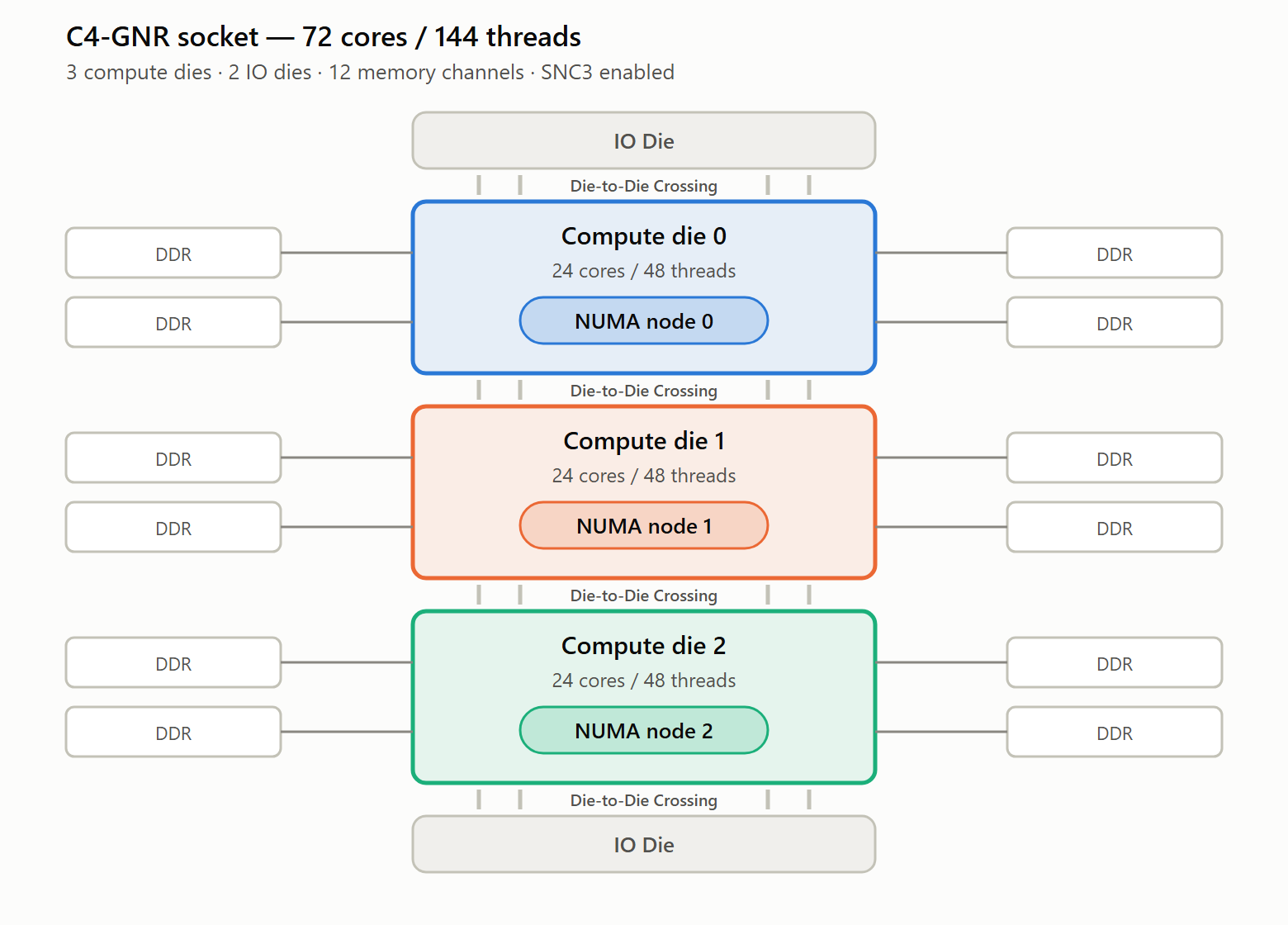
A full 2-socket system is 6 compute dies and 6 NUMA nodes.
Per-socket comparison
| Cores per socket | vCPUs per socket | NUMA nodes per socket | |
|---|---|---|---|
| C3 | 44 | 88 | 2 |
| C4-GNR | 72 | 144 | 3 |
Sockets by VM size
| vCPUs | SPR shape (c3) | c3 sockets | GNR shape (c4-GNR) | c4 sockets |
|---|---|---|---|---|
| 4 | c3-standard-4 |
1 | c4-standard-4 |
1 |
| 8 | c3-standard-8 |
1 | c4-standard-8 |
1 |
| 16 | NA | NA | c4-standard-16 |
1 |
| 22 | c3-standard-22 |
1 | NA | NA |
| 24 | NA | NA | c4-standard-24 |
1 |
| 32 | NA | NA | c4-standard-32 |
1 |
| 44 | c3-standard-44 |
1 | NA | NA |
| 48 | NA | NA | c4-standard-48 |
1 |
| 88 | c3-standard-88 |
1 | NA | NA |
| 96 | NA | NA | c4-standard-96 |
1 |
| 144 | NA | NA | c4-standard-144 |
1 |
| 176 | c3-standard-176 |
2 | NA | NA |
| 192 | c3-standard-192-metal |
2 | c4-standard-192 |
2 |
| 288 | NA | NA | c4-standard-288 |
2 |
NUMA nodes by VM size
| vCPUs | SPR shape (c3) | c3 NUMA | GNR shape (c4-GNR) | c4 NUMA |
|---|---|---|---|---|
| 4 | c3-standard-4 |
1 | c4-standard-4 |
1 |
| 8 | c3-standard-8 |
1 | c4-standard-8 |
1 |
| 16 | NA | NA | c4-standard-16 |
1 |
| 22 | c3-standard-22 |
1 | NA | NA |
| 24 | NA | NA | c4-standard-24 |
1 |
| 32 | NA | NA | c4-standard-32 |
1 |
| 44 | c3-standard-44 |
1 | NA | NA |
| 48 | NA | NA | c4-standard-48 |
1 |
| 88 | c3-standard-88 |
2 | NA | NA |
| 96 | NA | NA | c4-standard-96 |
2 |
| 144 | NA | NA | c4-standard-144 |
3 |
| 176 | c3-standard-176 |
4 | NA | NA |
| 192 | c3-standard-192-metal |
4 | c4-standard-192 |
4 |
| 288 | NA | NA | c4-standard-288 |
6 |
C4-GNR NUMA node and compute die layout by shape
| Shape | vCPUs | Sockets | NUMA nodes | vCPUs/node | Cores/node | Compute die coverage |
|---|---|---|---|---|---|---|
c4-standard-4 |
4 | 1 | 1 | 4 | 2 | Partial compute die |
c4-standard-8 |
8 | 1 | 1 | 8 | 4 | Partial compute die |
c4-standard-16 |
16 | 1 | 1 | 16 | 8 | Partial compute die |
c4-standard-24 |
24 | 1 | 1 | 24 | 12 | Partial compute die |
c4-standard-32 |
32 | 1 | 1 | 32 | 16 | Partial compute die |
c4-standard-48 |
48 | 1 | 1 | 48 | 24 | 1 full compute die |
c4-standard-96 |
96 | 1 | 2 | 48 | 24 | 2 full compute dies |
c4-standard-144 |
144 | 1 | 3 | 48 | 24 | Single socket (3 compute dies) |
c4-standard-192 |
192 | 2 | 4 | 48 | 24 | 2 compute dies per socket |
c4-standard-288 |
288 | 2 | 6 | 48 | 24 | Full system (6 compute dies) |
Note — the vCPUs/node and Cores/node columns are derived (vCPUs ÷ NUMA nodes, halved for Hyper-Threading). A compute die is 24 cores, so
c4-standard-48is 48 vCPUs = 24 cores = one full compute die.
Practical guidance
- Shapes up to
c4-standard-48are a single NUMA node, so NUMA placement and pinning are moot there.c4-standard-48is exactly one full compute die. - Node width is a uniform 48 vCPUs / 24 cores at every multi-node shape — simpler than C3, where a node is 44 vCPUs.
c4-standard-192is split evenly across sockets. It reports 2 sockets and 4 NUMA nodes, laid out as 2 nodes per socket, so it uses 2 of the 3 compute dies on each socket. This matches the 2 sockets × 2 nodes layout ofc3-standard-192-metal.c4-standard-144is the largest shape with no cross-socket traffic (3 nodes, single socket).- Verify the topology on a running instance with
lscpuornumactl -H.
Intel Architecture Instance Types on Google Cloud
| Category | Purpose |
|---|---|
| General Compute (N1, N2, N4) | Balanced compute, memory, and network resources for general-purpose workloads: analytics, databases, enterprise applications. |
| Compute-Optimized (C2, C3, C4, H3, C3.Metal) | Enhanced execution resources for compute-bound workloads: data science, ML/AI inference, gaming, HPC. |
| Memory-Optimized / Large Memory / Storage-Optimized (M1, M2, M3, M4, X4, Z3) | Enhanced memory or storage for memory-bound / IOPS-bound workloads: in-memory databases and analytics, SQL, HANA. |
| VMware (VE1, VE2) | Google Cloud VMware Engine (GCVE), optimized for VMware workloads. |
Processor generation mapping
| Intel generation | Google Cloud machine series |
|---|---|
| 5th / 6th Gen Intel Xeon Scalable | N4, C4, X4, M4, C3 w/ Confidential Compute (Intel TDX), C3.Metal |
| 4th Gen Intel Xeon Scalable | C3, H3, VE2, Z3 |
| 3rd Gen Intel Xeon Scalable | N2 w/ Ice Lake |
| 2nd Gen Intel Xeon Scalable | N2, C2, M2, VE1 |
| Intel Xeon Scalable processors | N1, M1 |
| Intel Xeon v4 and earlier | N1, M1 (earlier variants) |
Machine Series Comparison: C4-EMR vs C4-GNR
| C4 (EMR) | C4 (GNR) | |
|---|---|---|
| Predefined shapes | Up to 192 vCPU, 1,536 GB RAM | Up to 288 vCPU, 2,232 GB RAM |
| Custom shapes | N/A | N/A |
| Implementation | Shapes aligned to processor architecture, enabling maximum isolation and consistency | Shapes aligned to processor architecture, enabling maximum isolation and consistency |
| Frequency | Up to 4.0 GHz (single-core max turbo) | Up to 4.2 GHz (single-core max turbo) |
| Hyperdisk Balanced | Up to 320K IOPS, up to 10,000 MiB/s | Up to 320K IOPS, up to 12,500 MiB/s |
| Hyperdisk Extreme | Up to 500K IOPS, up to 10,000 MiB/s | Up to 500K IOPS, up to 10,000 MiB/s |
| Hyperdisk Throughput | Up to 40K IOPS, up to 10,000 MiB/s | Up to 40K IOPS, up to 10,000 MiB/s |
| Local SSD | N/A | Standard, Highmem |
| Networking (standard) | Up to 100 Gbps | Up to 100 Gbps |
| Networking (Tier_1) | Up to 200 Gbps | Up to 200 Gbps |
| Maintenance | Advanced maintenance | Standard maintenance |
| Additional features | Sole Tenancy, compact + spread placement | Sole Tenancy (coming soon), spread placement, Confidential Compute |
| Billing / consumption | Standard CUDs, Flex CUDs, Spot, Reservations | Standard CUDs, Flex CUDs, Spot, Reservations |
Note — the Hyperdisk rows are the per-shape ceilings from Hyperdisk performance limits. Google states them per machine type, not per CPU platform, and in MiB/s: the EMR column is
c4-*-192(the largest Emerald Rapids shape) and the GNR column isc4-*-288. Which shapes land on which processor is documented in C4 machine series —-lssdand-metalshapes plus the 144- and 288-vCPU shapes are Granite Rapids (andc4-standard-192can also be Granite Rapids). Starting an instance with--min-cpu-platform="Intel Granite Rapids"guarantees that the C4 instance is Granite Rapids. Smaller shapes are capped well below these numbers, so check the limits table for the specific shape rather than reading these as available at any size.
The high performance of C4 is a good fit for:
- Databases and caches
- Network appliances
- High-traffic web and application servers, analytics
- Real-time CPU-based inference, with Intel AMX
What C4 on Xeon 6 Adds
The C4 machine series expands to the latest Intel Xeon 6 processor (Granite Rapids), delivering new capabilities, more shape options, and greater flexibility — targeting databases, analytics, gaming, real-time platforms, and inference.
- C4 with Titanium Local SSD — new VM shapes featuring Titanium Local SSDs for I/O-intensive applications.
- C4 Bare Metal — new bare metal shapes for customers needing maximum control and flexibility.
- Larger C4 shapes — higher frequencies, larger cache sizes, and up to 2.2 TB of memory, reaching up to 4.2 GHz. Enables databases, data analytics, and other memory-bound or license-constrained workloads to scale effectively.
SPR to GNR in a Single Socket
| SPR | GNR | |
|---|---|---|
| Frequency (all-core turbo) | 3.0 GHz | 3.9 GHz |
| vCPUs | 88 | 144 |
| Memory channels | 8 | 12 |
| Memory speed | 4800 MT/s | 6400 MT/s |
| SNC | SNC2 or SNC4 | SNC3 |
| Hyper-Threading | On | On |
| SSD | N/A | Yes |
Example SPR instance: c3-standard-88 · Example GNR instance: c4-standard-144
Identifying a GNR-backed C4
- All
-lssdshapes are GNR, but GNR shapes without local SSD also exist (e.g.c4-standard-192), so the reliable way to get GNR is to start the instance with--min-cpu-platform="Intel Granite Rapids". - GNR-backed C4 instance types display “Intel Granite Rapids” on the GCP instance page. The
C4name alone does not guarantee GNR unless the page shows “Intel Granite Rapids”.