GNR (8i) on AWS
Notes on AWS EC2 8i instances — the Granite Rapids (Intel Xeon 6) generation — focused on NUMA/SNC3 topology, plus key features, specifications versus prior generations, and the resulting strengths.
See also: GNR (C4) on GCP — the same processor generation on Google Cloud — and Cross-Cloud Comparison for the AWS-versus-GCP node-width differences.
Contents
- NUMA Topology
- Intel Architecture Instance Types on AWS
- AWS GNR Instances & Key Features
- Specifications: 6i vs 7i vs 8i (per socket)
- Differentiation: Strengths
NUMA Topology
8i instances expose the Intel Xeon 6 SNC3 feature for best performance. Each socket is presented to the OS as 3 NUMA nodes, each with 32 cores and memory closer to those cores, giving the best memory latencies for NUMA-aware applications.
SNC3 architecture
Each GNR socket contains 3 compute dies and 12 memory channels. With SNC3 enabled, each compute die is presented as its own NUMA node:
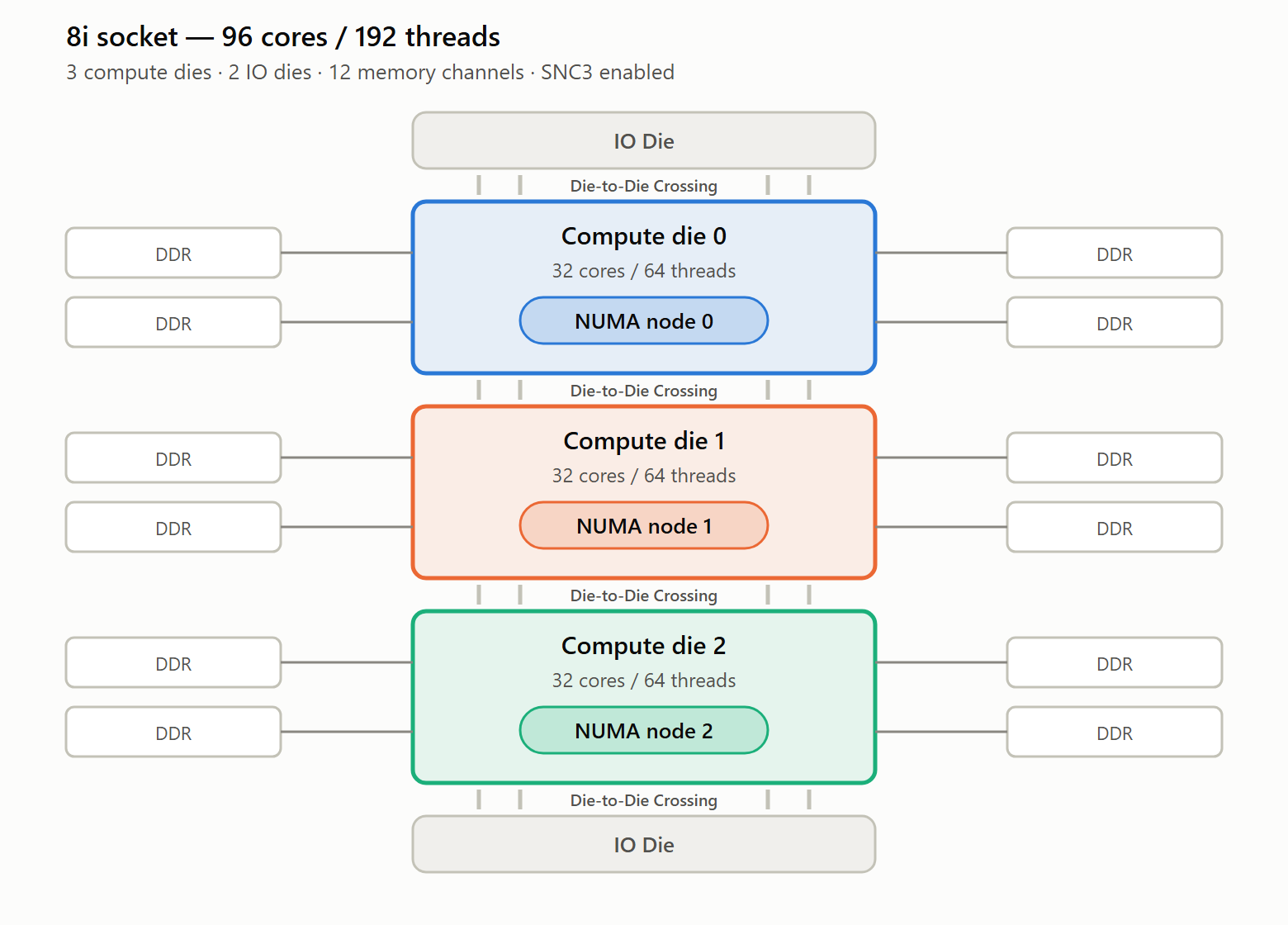
- 32 cores / 64 threads per NUMA node
- Memory from 4 channels attached to each node
- Memory in the other clusters of the same socket is remote-cluster memory
Per-socket comparison
| Cores/socket | vCPUs/socket | NUMA nodes/socket | |
|---|---|---|---|
| 6i | 32 | 64 | 1 |
| 7i | 48 | 96 | 1 |
| 8i | 96 | 192 | 3 |
Sockets by VM size
| VM size | 6i sockets | 7i sockets | 8i sockets |
|---|---|---|---|
| 4xl | 1 | 1 | 1 |
| 8xl | 1 | 1 | 1 |
| 12xl | 1 | 1 | 1 |
| 16xl | 1 | 1 | 1 |
| 24xl | 2 | 1 | 1 |
| 32xl | 2 | NA | 1 |
| 48xl | NA | 2 | 1 |
| 96xl | NA | NA | 2 |
Note — 8i reaches 48xl within a single socket, where 7i needs two.
NUMA nodes by VM size
| VM size | 6i NUMA | 7i NUMA | 8i NUMA |
|---|---|---|---|
| 4xl | 1 | 1 | 1 |
| 8xl | 1 | 1 | 1 |
| 12xl | 1 | 1 | 1 |
| 16xl | 1 | 1 | 1 |
| 24xl | 2 | 1 | 2 |
| 32xl | 2 | NA | 2 |
| 48xl | NA | 2 | 3 |
| 96xl | NA | NA | 6 |
8i NUMA node and compute die layout by VM size
| VM size | vCPUs | Sockets | NUMA nodes | vCPUs/node | Cores/node | Compute die coverage |
|---|---|---|---|---|---|---|
| 4xl | 16 | 1 | 1 | 16 | 8 | Partial compute die |
| 8xl | 32 | 1 | 1 | 32 | 16 | Partial compute die |
| 12xl | 48 | 1 | 1 | 48 | 24 | Partial compute die |
| 16xl | 64 | 1 | 1 | 64 | 32 | 1 full compute die |
| 24xl | 96 | 1 | 2 | 48 | 24 | 2 partial compute dies |
| 32xl | 128 | 1 | 2 | 64 | 32 | 2 full compute dies |
| 48xl | 192 | 1 | 3 | 64 | 32 | Single socket (3 compute dies) |
| 96xl | 384 | 2 | 6 | 64 | 32 | Full system (6 compute dies) |
Note — the vCPUs/node and Cores/node columns are derived (vCPUs ÷ NUMA nodes, halved for Hyper-Threading).
Practical guidance
- Sizes up to 16xl are a single NUMA node, so NUMA placement and pinning are moot there.
- 24xl and 32xl span 2 nodes, 48xl spans 3 nodes within one socket, and 96xl spans 6 nodes across 2 sockets. 48xl is the largest size with no cross-socket traffic.
- Node width is not always 32 cores. 24xl is built from 2 partial dies (24 cores each), so a node there exposes fewer cores than a full die.
- Verify the topology on a running instance with
lscpuornumactl -H.
Intel Architecture Instance Types on AWS
AWS offers Intel-based instances across every major family. Instance families are grouped by workload profile:
| Family | Purpose |
|---|---|
| General Purpose (M, T) | Balance of compute, memory, and networking for diverse workloads. |
| Compute Optimized (C) | Compute-bound applications that benefit from high performance processors. |
| Memory Optimized (R, X, U, z1d) | Fast performance for workloads processing large in-memory data sets. |
| Storage Optimized (I, D, H) | High sequential read/write access to very large data sets on local storage. |
| Accelerated Compute (P, G, F, DL1) | Hardware accelerators / co-processors for specialized functions. |
| HPC Optimized (HPC6id) | Large, complex simulations and deep learning workloads. |
Processor generation mapping
| AWS naming | Intel generation | Codename |
|---|---|---|
8i (M8i, C8i, R8i, X8i, plus -flex and d variants) |
Intel Xeon 6 | Granite Rapids |
| I7i, I7ie | 5th Gen Intel Xeon Scalable | Emerald Rapids |
7i (M7i, C7i, R7i, R7iz, U7i, U7in, U7inh, plus -flex variants) |
4th Gen Intel Xeon Scalable | Sapphire Rapids |
| 6i (M6i, C6i, R6i, X2idn, X2iedn, I4i) | 3rd Gen Intel Xeon Scalable | Ice Lake |
| 5-series, later parts (M5n, R5n, X2iezn) | 2nd Gen Intel Xeon Scalable | Cascade Lake |
| 5-series, early parts (M5, C5, R5, z1d, I3en) | Intel Xeon Scalable | Skylake |
| M4, C4, R4, X1, D2 | Intel Xeon v3 / v4 | Haswell / Broadwell, varies by size |
Note — the AWS generation digit does not track the Intel generation. I7i is Emerald Rapids, one Intel generation newer than the Sapphire Rapids M7i/C7i/R7i, because the storage-optimized line numbers independently of the compute lines. No AWS
7icompute family is Emerald Rapids at all: those went Sapphire Rapids (7i) straight to Granite Rapids (8i). Confirm the processor for a specific instance type in the AWS specification tables rather than inferring it from the name.
Note — the 8i row is Intel Xeon 6, not “6th Gen Intel Xeon Scalable”; Intel dropped the “Nth Gen … Scalable” scheme for this generation, and AWS follows the Xeon 6 branding.
AWS instance suffix decoder
| Suffix | Meaning |
|---|---|
d |
Instance store volumes |
n |
Network and EBS optimized |
e |
Extra storage or memory |
z |
High performance |
-flex |
Flex variant (see the AWS references below) |
Reference: https://aws.amazon.com/ec2/instance-types/ and https://docs.aws.amazon.com/AWSEC2/latest/UserGuide/instance-types.html
The per-instance-type processor is listed in the AWS specification tables, which are the source for the mapping above: general purpose, compute optimized, memory optimized, storage optimized.
AWS GNR Instances & Key Features
- Powered by custom Xeon 6 processors — 96 cores / 192 threads per socket
- Sustained all-core turbo frequency of 3.9 GHz
- DDR5-7200 memory across 12 channels per socket
- 480 MB L3 cache per socket
- AMX improvements
- Higher network and EBS bandwidth than 7i (see the AWS specification tables linked above)
- Two new instance sizes: 32xlarge (versus SPR) and 96xlarge
vCPU-to-memory ratio by family
| Instance families | Memory per vCPU (GB) |
|---|---|
| C8i, C8i-flex, C8id | 2 |
| M8i, M8i-flex, M8id | 4 |
| R8i, R8i-flex, R8id | 8 |
| X8i | 16 |
Instance sizes
| Size | vCPUs |
|---|---|
| large | 2 |
| xlarge | 4 |
| 2xlarge | 8 |
| 4xlarge | 16 |
| 8xlarge | 32 |
| 12xlarge | 48 |
| 16xlarge | 64 |
| 24xlarge | 96 |
| 32xlarge | 128 |
| 48xlarge | 192 |
| 96xlarge | 384 |
| metal-48xl | 192 |
| metal-96xl | 384 |
Specifications: 6i vs 7i vs 8i (per socket)
| 6i | 7i | 8i | |
|---|---|---|---|
| Micro architecture | Ice Lake | Sapphire Rapids | Granite Rapids |
| Cores per socket | 32 | 48 | 96 |
| vCPUs per socket | 64 | 96 | 192 |
| Max frequency | 3.5 GHz | 3.8 GHz | 3.9 GHz |
| All-core frequency | 3.5 GHz | 3.2 GHz | 3.9 GHz |
| Memory | DDR4-3200 | DDR5-4800 | DDR5-7200 |
| L2 cache per core | 1.3 MB | 2 MB | 2 MB |
| L3 cache | 54 MB | 210 MB | 480 MB |
| Memory channels | 8 | 8 | 12 |
| Sub-NUMA Cluster (SNC) | No | No | Yes (SNC3) |
| TDP | 300 W | 385 W | 600 W |
| Accelerators | — | AMX, QAT, IAA/DSA, DLB | AMX, QAT, IAA/DSA, DLB |
Differentiation: Strengths
- Consistent single-core and all-core turbo frequency (3.9 GHz)
- Largest system offering — 384 vCPUs / 6 TB memory
- Largest single-socket offering — 192 vCPUs / 3 TB memory
- Consistent performance metrics/events (PMU) across all VM sizes
- Accelerators targeting specific customer scenarios:
- AMX — AI workloads
- QAT — crypto, compression/decompression
- IAA/DSA — analytics, compression/decompression (zram, zswap)