Tuning Strategies
Introduction
Intel® Neural Compressor aims to help users quickly deploy
the low-precision inference solution on popular Deep Learning frameworks
such as TensorFlow, PyTorch, and MxNet. Using built-in strategies, it
automatically optimizes low-precision recipes for deep learning models to
achieve optimal product objectives, such as inference performance and memory
usage, with expected accuracy criteria. Currently, it supports Basic, Bayesian, Exhaustive, MSE, Random, SigOpt and TPE strategies. Basic is
the default strategy.
Strategy Design
Each strategy generates the next quantization configuration according to its logic and the last quantization result. The function of strategies is shown below:
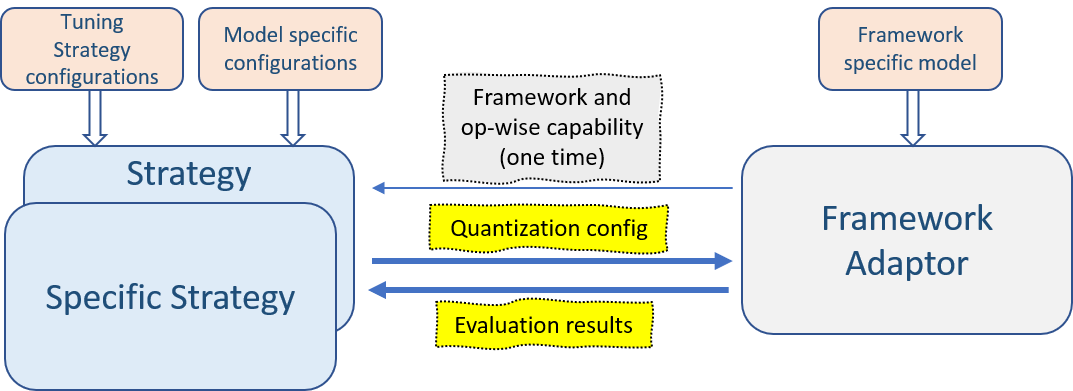
Strategies begin with an adaptor layer (Framework Adaptor) where the user
passes a framework-specific model to initialize an instance of the
neural_compressor.Quantization() class; strategies call the self.adaptor.query_fw_capability(model) to get the framework and
model-specific quantization capabilities. From there, each strategy merges
model-specific configurations in a yaml configuration file to filter some
capability from the first step in order to generate the tuning space. Each
strategy then generates the quantization config according to its location
and logic with tuning strategy configurations from the yaml configuration
file. All strategies finish the tuning processing when the timeout or max_trails is reached. The default value of timeout is 0; if reached, the
tuning phase stops when the accuracy criteria is met.
Configurations
Detailed configuration templates can be found here.
Model-specific configurations
For model-specific configurations, users can set the quantization approach. For post-training static quantization, users can also set calibration and quantization-related parameters for model-wise and op-wise:
quantization:                                        # optional. tuning constraints on model-wise for advance user to reduce tuning space.
  approach: post_training_static_quant               # optional. default value is post_training_static_quant.
  recipes:
    scale_propagation_max_pooling: True              # optional. default value is True.
    scale_propagation_concat: True                   # optional. default value is True.
    first_conv_or_matmul_quantization: True          # optional. default value is True.
  calibration:
    sampling_size: 1000, 2000                        # optional. default value is 100. used to set how many samples should be used in calibration.
    dataloader:                                      # optional. if not specified, user need construct a q_dataloader in code for neural_compressor.Quantization.
      dataset:
        TFRecordDataset:
          root: /path/to/tf_record
      transform:
        Resize:
          size: 256
        CenterCrop:
          size: 224
  model_wise:                                        # optional. tuning constraints on model-wise for advance user to reduce tuning space.
    weight:
      granularity: per_channel
      scheme: asym
      dtype: int8
      algorithm: minmax
    activation:
      granularity: per_tensor
      scheme: asym
      dtype: int8, fp32
      algorithm: minmax, kl
  op_wise: {                                         # optional. tuning constraints on op-wise for advance user to reduce tuning space.
         'conv1': {
           'activation':  {'dtype': ['uint8', 'fp32'], 'algorithm': ['minmax', 'kl'], 'scheme':['sym']},
           'weight': {'dtype': ['int8', 'fp32'], 'algorithm': ['kl']}
         },
         'pool1': {
           'activation': {'dtype': ['int8'], 'scheme': ['sym'], 'granularity': ['per_tensor'], 'algorithm': ['minmax', 'kl']},
         },
         'conv2': {
           'activation':  {'dtype': ['fp32']},
           'weight': {'dtype': ['fp32']}
         }
       }
Basic
Design
Basic strategy is designed for most models to do quantization. It includes
three steps. First, Basic strategy tries all model-wise tuning configs to
get the best quantized model. If none of the model-wise tuning configs meet
the accuracy loss criteria, Basic applies the second step. In this step, it
performs high-precision OP (FP32, BF16 …) fallbacks one-by-one based
on the best model-wise tuning config, and records the impact of each OP on
accuracy and then sorts accordingly. In the final step, Basic tries to
incrementally fallback multiple OPs to high precision according to the
sorted OP list that is generated in the second step until the accuracy
goal is achieved.
Usage
Basic is the default strategy. It can be used by default if you don’t add
the strategy field in your yaml configuration file. Classical settings in the configuration file are shown below:
tuning:
  accuracy_criterion:
    relative:  0.01
  exit_policy:
    timeout: 0
  random_seed: 9527
Bayesian
Design
Bayesian optimization is a sequential design strategy for the global
optimization of black-box functions. This strategy comes from the Bayesian
optimization package and
changed it to a discrete version that complied with the strategy standard of
Intel® Neural Compressor. It uses Gaussian processes to define
the prior/posterior distribution over the black-box function with the tuning
history, and then finds the tuning configuration that maximizes the expected
improvement. For now, Bayesian just focus on op-wise quantize configs tuning
without fallback phase. In order to obtain a quantized model with good accuracy
and better performance in a short time, we don’t add datatype as a tuning
parameter into Bayesian.
Usage
For the Bayesian strategy, set the timeout or max_trials to a non-zero
value as shown in the below example. This is because the param space for bayesian can be very small so the accuracy goal might not be reached which
can make the tuning never end. Additionally, if the log level is set to debug by LOGLEVEL=DEBUG in the environment, the message [DEBUG] Tuning config was evaluated, skip! will print endlessly. If the timeout is changed from 0 to an integer, Bayesian ends after the timeout is reached.
tuning:
  strategy:
    name: bayesian
  accuracy_criterion:
    relative:  0.01
  objective: performance

  exit_policy:
    timeout: 0
    max_trials: 100
MSE
Design
MSE and Basic strategies share similar ideas. The primary difference
between the two strategies is the way sorted op lists are generated in step
2. The MSE strategy needs to get the tensors for each operator of raw FP32
models and the quantized model based on the best model-wise tuning
configuration. It then calculates the MSE (Mean Squared Error) for each
operator, sorts those operators according to the MSE value, and performs
the op-wise fallback in this order.
Usage
MSE is similar to Basic but the specific strategy name of mse must be
included.
tuning:
  strategy:
    name: mse
  accuracy_criterion:
    relative:  0.01
  exit_policy:
    timeout: 0
  random_seed: 9527
TPE
Design
TPE uses sequential model-based optimization methods (SMBOs). **Sequential
** refers to running trials one after another and selecting a better
hyperparameter to evaluate based on previous trials. A hyperparameter is
a parameter whose value is set before the learning process begins; it
controls the learning process. SMBO apples Bayesian reasoning in that it
updates a surrogate model that represents an objective function
(objective functions are more expensive to compute). Specifically, it finds
hyperparameters that perform best on the surrogate and then applies them to
the objective function. The process is repeated and the surrogate is updated
with incorporated new results until the timeout or max trials is reached.
A surrogate model and selection criteria can be built in a variety of ways.
TPE builds a surrogate model by applying Bayesian reasoning. The TPE
algorithm consists of the following steps:
Define a domain of hyperparameter search space.
Create an objective function which takes in hyperparameters and outputs a score (e.g., loss, RMSE, cross-entropy) that we want to minimize.
Collect a few observations (score) using a randomly selected set of hyperparameters.
Sort the collected observations by score and divide them into two groups based on some quantile. The first group (x1) contains observations that gives the best scores and the second one (x2) contains all other observations.
Model the two densities l(x1) and g(x2) using Parzen Estimators (also known as kernel density estimators) which are a simple average of kernels centered on existing data points.
Draw sample hyperparameters from l(x1). Evaluate them in terms of l(x1)/g(x2), and return the set that yields the minimum value under l(x1)/g(x1) that corresponds to the greatest expected improvement. Evaluate these hyperparameters on the objective function.
Update the observation list in step 3.
Repeat steps 4-7 with a fixed number of trials.
Note: TPE requires many iterations in order to reach an optimal solution; we recommend running at least 200 iterations. Because every iteration requires evaluation of a generated model–which means accuracy measurements on a dataset and latency measurements using a benchmark–this process can take from 24 hours to few days to complete, depending on the model.
Usage
TPE usage is similar to Bayesian:
tuning:
  strategy:
    name: bayesian
  accuracy_criterion:
    relative:  0.01
  objective: performance

  exit_policy:
    timeout: 0
    max_trials: 100
Exhaustive
Design
Exhaustive strategy is used to sequentially traverse all possible tuning
configurations in a tuning space. From the perspective of the impact on
performance, we currently only traverse all possible quantize tuning
configs. Same reason as Bayesian, fallback datatypes are not included for now.
Usage
Exhaustive usage is similar to Basic:
tuning:
  strategy:
    name: exhaustive
  accuracy_criterion:
    relative:  0.01
  exit_policy:
    timeout: 0
  random_seed: 9527
Random
Design
Random strategy is used to randomly choose tuning configurations from the
tuning space. As with Exhaustive strategy, it also only considers quantize
tuning configs to generate a better-performance quantized model.
Usage
Random usage is similar to Basic:
tuning:
  strategy:
    name: random
  accuracy_criterion:
    relative:  0.01
  exit_policy:
    timeout: 0
  random_seed: 9527
SigOpt
Design
SigOpt strategy is to use SigOpt Optimization Loop method to accelerate and visualize the traversal of the tuning configurations from the tuning space. The metrics add accuracy as constraint and optimize for latency to improve the performance. SigOpt Projects can show the result of each tuning experiment.
Usage
Compare to Basic, sigopt_api_token and sigopt_project_id is necessary for SigOpt.sigopt_experiment_name is optional, the default name is nc-tune.
tuning:
  strategy:
    name: sigopt
    sigopt_api_token: YOUR-ACCOUNT-API-TOKEN
    sigopt_project_id: PROJECT-ID
    sigopt_experiment_name: nc-tune
  accuracy_criterion:
    relative:  0.01
  exit_policy:
    timeout: 0
  random_seed: 9527
For details, how to use sigopt strategy in neural_compressor is available.
Customize a New Tuning Strategy
Intel® Neural Compressor supports new strategy extension by implementing a subclass of TuneStrategy class in neural_compressor.strategy package
and registering this strategy by strategy_registry decorator.
for example, user can implement a Abc strategy like below:
@strategy_registry
class AbcTuneStrategy(TuneStrategy):
    def __init__(self, model, conf, q_dataloader, q_func=None,
                 eval_dataloader=None, eval_func=None, dicts=None):
        ...

    def next_tune_cfg(self):
        ...
The next_tune_cfg function is used to yield the next tune configuration according to some algorithm or strategy. TuneStrategy base class will traverse
all the tuning space till a quantization configuration meets pre-defined accuracy criterion.
If the traverse behavior of TuneStrategy base class does not meet new strategy requirement, it could re-implement traverse function with self own logic.
An example like this is under TPE Strategy.